Showing posts with label Wish I Could Write Like That. Show all posts

Wednesday, May 12, 2010

In Cold Blood


It begins:
The village of Holcomb stands on the high wheat plains of western Kansas, a lonesome area that other Kansans call "out there." Some seventy miles east of the Colorado border, the countryside, with its hard blue skies and desert-clear air, has an atmosphere that is rather more Far West than Middle West. The local accent is barbed with a prairie twang, a ranch-hand nasalness, and the men, many of them, wear narrow frontier trousers, Stetsons, and high-heeled boots with pointed toes. The land is flat, and the views are awesomely extensive; horses, herds of cattle, a white cluster of grain elevators rising as gracefully as Greek temples are visible long before a traveler reaches them.

Later:
"It doesn't make sense. I mean what happened. It had nothing to do with the Clutters. They never hurt me. They just happened to be there. I thought Mr. Clutter was a very nice gentleman... I thought so right up to the time I cut his throat."

TRUMAN CAPOTE

Tuesday, May 4, 2010

Soldiers' Pay


The air was sweet with fresh-sawed lumber and they walked through a pale yellow city of symmetrical stacked planks. a continuous line of negroes carried boards up a cleated incline like a chicken run into a freight car and flung them clashing to the floor, under the eye of an informally clad white man who reclined easily upon a lumber pile, chewing indolent tobacco. He watched them with interest as they passed, following the faint wagon road.
Chapter IV, 4

Mahon liked music; so Mrs. Worthington sent her car for them. Mrs. Worthington lived in a large, beautiful old house which her husband, conveniently dead, had bequeathed, with a colorless male cousin who had false teeth and no occupation that anyone knew of, to her. The male cousin's articulation was bad (he had been struck in the mouth with an ax in a dice game in Cuba during the Spanish-American War): perhaps this was why he did nothing.
Chapter V, 7)

Jones looked up with his customary phlegmatic calm, then he rose, lazily courteous. She watched him narrowly with the terror-sharpened cunning of an animal, but his face and manner told nothing.
Chapter VI, 1

The sentries in her blood lay down, but they lay down near the ramparts with their arms in their hands, waiting the alarm, the inevitable stand-to, and they sat clasped in the vaguely gleamed twilight of the room, Jones a fat Mirandola in a chaste Platonic nympholepsy, a religio-sentimental orgy in gray tweed, shaping an insincere, fleeting articulation of damp clay to an old imperishable desire, building himself a papier mâché Virgin: and Cecily Saunders wondering what, how much he had heard, frightened and determined.
Chapter VI, 2)

"Soldiers' Pay" was William Faulkner's first novel, written while he lived in New Orleans and published in 1926.

Friday, April 30, 2010

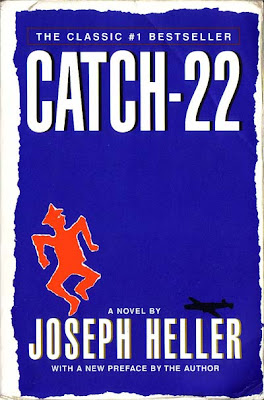
Catch 22


"They're trying to kill me," Yossarian told him calmly.
"No one's trying to kill you," Clevinger cried.
"Then why are they shooting at me?" Yossarian asked.
"They're shooting at everyone," Clevinger answered. "They're trying to kill everyone."
"And what difference does that make?"
Yossarian explains to his friend Clevinger why he is not crazy for thinking people are trying to kill him, Chapter 2: Clevinger.

There was only one catch and that was Catch-22, which specified that a concern for one's own safety in the face of dangers that were real and immediate was the process of a rational mind. Orr was crazy and could be grounded. All he had to do was ask; and as soon as he did, he would no longer be crazy and would have to fly more missions. Orr would be crazy to fly more missions and sane if he didn't, but if he was sane he had to fly them. If he flew them he was crazy and didn't have to; but if he didn't want to he was sane and had to. Yossarian was moved very deeply by the absolute simplicity of this clause of Catch-22 and let out a respectful whistle.
"That's some catch, that catch-22," he observed.
"It's the best there is," Doc Daneeka agreed.
Doc Daneeka explains why he cannot ground Yossarian or Orr due to insanity, Chapter 5: Chief White Halfoat.

"Catch-22...says you've always got to do what your commanding officer tells you to."
"But Twenty-seventh Air Force says I can go home with forty missions."
"But they don't say you have to go home. And regulations do say you have to obey every order. That's the catch. Even if the colonel were disobeying a Twenty-seventh Air Force order by making you fly more missions, you'd still have to fly them, or you'd be guilty of disobeying an order of his. And then the Twenty-seventh Air Force Headquarters would really jump on you."
Doc Daneeka reveals another clause of Catch-22 to Yossarian, Chapter 6: Hungry Joe.

Some men are born mediocre, some men achieve mediocrity, and some men have mediocrity thrust upon them.
Of Major Major, with whom it had been all three. Chapter 9: Major Major Major Major.

With a little ingenuity and vision, he had made it all but impossible for anyone in the squadron to talk to him, which was just fine with everyone, he noticed, since no one wanted to talk to him anyway.
Of Major Major. Chapter 9: Major Major Major Major.

Major Major never sees anyone in his office while he's in his office.
Sergeant Towser to Appleby. Chapter 10: Wintergreen.

Open your eyes, Clevinger. It doesn't make a damned bit of difference who wins the war to someone who's dead.
Yossarian, Chapter 12: Bologna.

It doesn't make sense. It isn't even good grammar. What the hell does it mean to disappear somebody?
Yossarian is told by Nurse Duckett that officials are planing to "disappear" Dunbar, Chapter 34: Thanksgiving.

Joseph Heller

Wednesday, April 28, 2010

To Kill A Mockingbird


Maycomb was an old town, but it was a tired old town when I first knew it. In rainy weather the streets turned to red slop; grass grew on sidewalks, the courthouse sagged in the square. Somehow, it was hotter then: a black dog suffered on a summer's day; bony mules hitched to Hoover carts flicked flies in the sweltering shade of the live oaks on the square. Men's stiff collars wilted by nine in the morning. Ladies bathed before noon, after their three-o'clock naps, and by nightfall were like soft teacakes with frostings of sweat and sweet talcum.
Scout (Jean Louise Finch) the narrator, Chapter 1.

The sixth grade seemed to please him from the beginning: he went through a brief Egyptian Period that baffled me - he tried to walk flat a great deal, sticking one arm in front of him and one in back of him, putting one foot behind the other. He declared Egyptians walked that way; I said if they did I didn't see how they got anything done, but Jem said they accomplished more than the Americans ever did, they invented toilet paper and perpetual embalming, and asked where would we be today if they hadn't? Atticus told me to delete the adjectives and I'd have the facts.
Scout, Chapter 7.

I was born good but had grown progressively worse every year.
Scout, Chapter 9.

When he gave us our air-rifles Atticus would'nt teach us to shoot. Uncle Jack instructed us in the rudiments thereof; he said Atticus wasn't interested in guns. Atticus said to Jem one day, "I'd rather you shoot at tin cans in the back yard, but I know you'll go after birds. Shoot all the bluejays you want, if you can hit 'em, but remember it's a sin to kill a mockingbird."

That was the only time I ever heard Atticus say it was a sin to do something, and I asked Miss Maudie about it.

"Your father's right," she said. "Mockingbirds don't do one thing but make music for us to enjoy. They don't eat up people's gardens, don't nest in corncribs, they don't do one thing but but sing their hearts out for us. That's why it's a sin to kill a mockingbird.
Scout, Miss Maudie, Chapter 10

I think there's just one kind of folks. Folks.
Scout, Chapter 23.

Neighbors bring food with death and flowers with sickness and little things in between. Boo was our neighbor. He gave us two soap dolls, a broken watch and chain, a pair of good-luck pennies, and our lives. But neighbors give in return. We never put back into the tree what we took out of it: we had given him nothing, and it made me sad.
Scout, Chapter 31.

Harper Lee